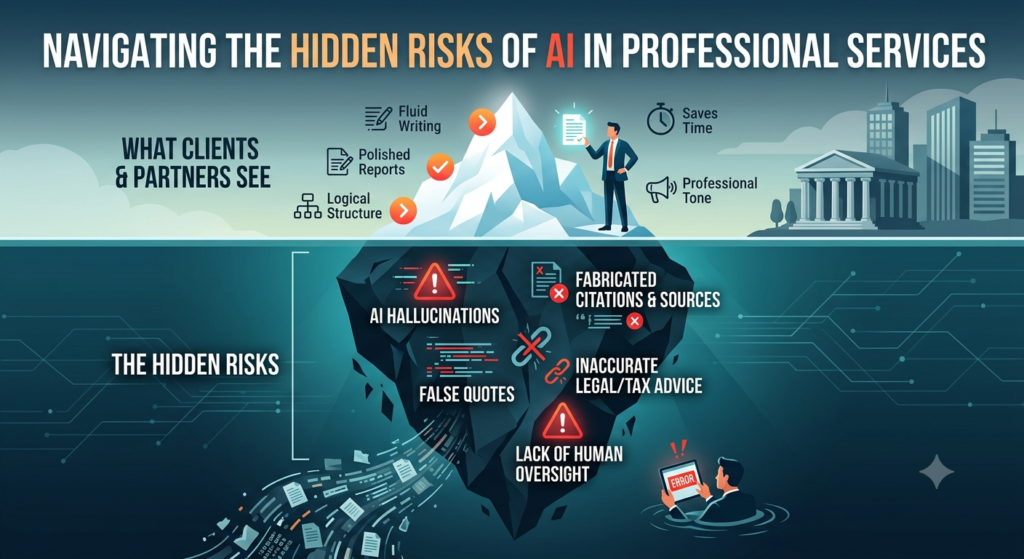
AI-generated content often looks and sounds professional. At least at first glance. But the veneer of expertise in AI content creation hides a huge risk.
In professional services, a smooth paragraph, a confident citation or a well-structured report can create the impression of expertise, even when the evidence behind it has not been properly checked.
Lawyers may use generative AI to create content such as case summaries and legal updates. Consultants use it to summarise research. Accountants and advisers use it to draft policy notes, reports and presentations.
This makes perfect sense. AI content creation can speed up drafting and help teams organise complex material quickly. Used with care, it can save time without reducing quality.
The danger begins when AI-generated content moves too casually from working draft to client-ready material.
Real cases of AI content creation
Recent examples show how quickly this can become a serious problem.
In 2025, Deloitte Australia agreed to refund part of a fee paid by the Australian government after a report on welfare compliance was found to include AI-generated errors. Reports said the document contained false quotes and a fake reference to a court decision.
In April 2026, law firm Sullivan & Cromwell apologised to a US federal judge after a court filing contained inaccurate legal citations and other errors linked to AI use. Reuters reported that the filing included AI “hallucinations”, including made-up citations and misquotations of law.
A month later, Pinsent Masons in the UK was reprimanded by London’s High Court after incorrect AI-generated legal citations were submitted in an insolvency case. According to the Law Gazette, a junior lawyer had used an AI tool that warned it might not be fully accurate. The firm apologised, self-reported to the Solicitors Regulation Authority and said it would improve oversight.
These are not amateur businesses experimenting at the edges. They are major professional firms, working in environments where review, evidence and responsibility should already be part of the process.
This is why the risk is needs to be taken seriously.
Professional services content carries authority
Professional services writing is different from ordinary marketing copy.
A legal summary, case commentary, financial report or consulting paper carries professional authority. Clients read it as evidence of expertise.
AI can disturb that relationship because it often prioritises fluency over reliability. It can make weak evidence look firm. It can turn an assumption into a confident paragraph. It can invent a citation that looks convincing on the page.
The weak point is often not the tool itself.
It is the trust people place in the output.
The problem is polish without proof
A report does not only lose credibility when its recommendations are wrong. It can also lose credibility when the supporting evidence cannot be trusted.
If a client discovers invented sources or inaccurate quotations, the question quickly becomes wider than the document itself.
What else was not checked?
How strong was the review process?
Who was accountable for the final version?
A rough draft created by a human often shows its weaknesses: notes to check, missing sources, awkward phrasing or a paragraph that plainly needs more work.
An AI draft hides those gaps behind tidy sentences.
A reviewer under time pressure may improve the tone without testing the facts. A senior partner may assume a citation has already been checked. A marketing team may publish a technical update because it reads well and came from a plausible source document.
This is how weak material becomes official.
The risk extends beyond your own team
Even when firms are careful in their own use of AI, there is also a supply chain risk. The brand that publishes the content carries the risk, even if the content was created elsewhere.
Many firms rely on outside writers, agencies, offshore research teams, or automated tools. If nobody asks how a piece of content was created, the firm may not know whether AI was used or whether the author checked the output.
A disclaimer may reduce risk. It cannot replace proper governance.
What firms should do now
The practical answer is not to ban AI. That would be unrealistic and, in many cases, unnecessary.
The better response is to decide where AI can help and where human judgement must remain visible.
Firms need rules that hold up during busy periods.
Every source must be checked. Every footnote reviewed. Every quotation traced. Every legal or regulatory claim must be reviewed by someone qualified to assess it.
Client-facing content should have a record of who reviewed it, what sources were used and whether AI played a role in the drafting process.
Third-party suppliers should also be asked to disclose how they use AI.
Trust is the asset at risk
Professional services firms sell expertise. Their writing is part of that expertise because it turns judgement into something clients can use.
When AI is allowed to produce content without proper review, it weakens the link between the firm’s knowledge and the information published in its name.
The real risk is not that AI writes badly, it’s that AI can write smoothly enough to make unchecked work look authoritative.
For professional services firms that rely on trust and reputation, that risk doesn’t only weaken their content. It can jeopardise the entire brand.